Overview
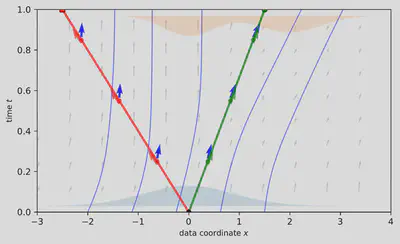
Flow Mismatching is an unsupervised anomaly detection method that does not rely on reconstruction. A flow matching model is trained only on normal images. For a test image, we compare the model’s learned velocity field with the direct geometric velocity toward that image along paths from noise. Where the two disagree, the image is anomalous; aggregating these velocity mismatches across time steps and paths gives pixel-wise anomaly heatmaps and image-level scores.
We also provide a theoretical decomposition of the mismatch, and report results on MVTec-AD and VisA that outperform reconstruction-based and other flow matching-based methods.
Accepted to NeurIPS 2026.
Toy-Example Demonstrations
A live interactive demo illustrates the velocity-mismatch mechanism on 2D toy data — a flow-matching model trained only on normal data, run toward a real data point and an off-manifold point from the same starting noise draws. Solid arrows show the model’s predicted velocity; dashed lines show the true heading. On the normal target they track each other; on the off-manifold target they visibly diverge, and that growing disagreement is the anomaly signal.
Try it yourself — drag the time slider (or press play). The demo shows the paper’s actual toy setup (Appendix B.1): an upper semicircle manifold, scored on the paper’s own grid and aggregation rule, with a near-manifold anomaly placed closer to the boundary than a simple off-manifold gap — a harder, more subtle detection case.
Bias-variance trade-off across ODE time
Flow Mismatching aggregates the velocity mismatch across many ODE times $t$ rather than reading it off a single $t$, because the mismatch signal itself trades bias for variance as $t$ varies. The figure below reproduces the paper’s own semicircle toy analysis (Appendix B.1): at small $t$, interpolated states are dominated by source noise, so the low-mismatch region is a broad blob covering the manifold’s interior — biased and poorly localized. At large $t$, the low-mismatch region localizes tightly to the manifold but becomes visibly speckled — high variance, since late-time states are far more sensitive to the specific noise draw. The paper’s $w(t) = t^2$-weighted combination over time balances the two regimes, yielding a score map that is both sharp and smooth.
Drag the slider to compare, side by side, the per-$t$ landscape (left) against the running $w(t)=t^2$-weighted combination up to that point (right):
Flow mismatching on a real image
The toy examples above use synthetic 2D data so the mechanism is easy to see; the same method applies directly to real images. Below is the velocity-mismatch heatmap computed on a real MVTec-AD test image — pick a category with the selector above the demo (more categories are added as they become available) — using the trained flow-mismatching model, no synthetic data, same per-$t$ computation and $w(t)=t^2$ time-weighting as the toy demos. The green outline marks the ground-truth defect region.
Resources
- Paper: arXiv:2605.23070
- Venue: NeurIPS 2026
BibTeX
@inproceedings{chen2026flowmismatching,
  title     = {Flow Mismatching: Unsupervised Anomaly Detection via Velocity Discrepancies in Flow Matching Models},
  author    = {Chen, Shengzhe and Moradi, Mehrdad and Paynabar, Kamran and Yan, Hao},
  booktitle = {Advances in Neural Information Processing Systems (NeurIPS)},
  year      = {2026},
  note      = {arXiv:2605.23070}
}